Hawaii Real Estate Search
Address Search
South Kona Real Estate: Captain Cook, Kealakekua and Honaunau (2026)

Quick answer (updated November 13, 2026): South Kona covers Captain Cook, Kealakekua, Honaunau and the slopes above Kealakekua Bay, the heart of Kona coffee country. October 2026 median prices (Title Guaranty Hawaii market report) show 9 South Kona house sales at an $810,000 median and 2 land sales at a $1.1 million median. It is mostly single-family homes and agricultural lots on Mauna Loa's slopes, so lava zone, water source, road access and farm use all matter.
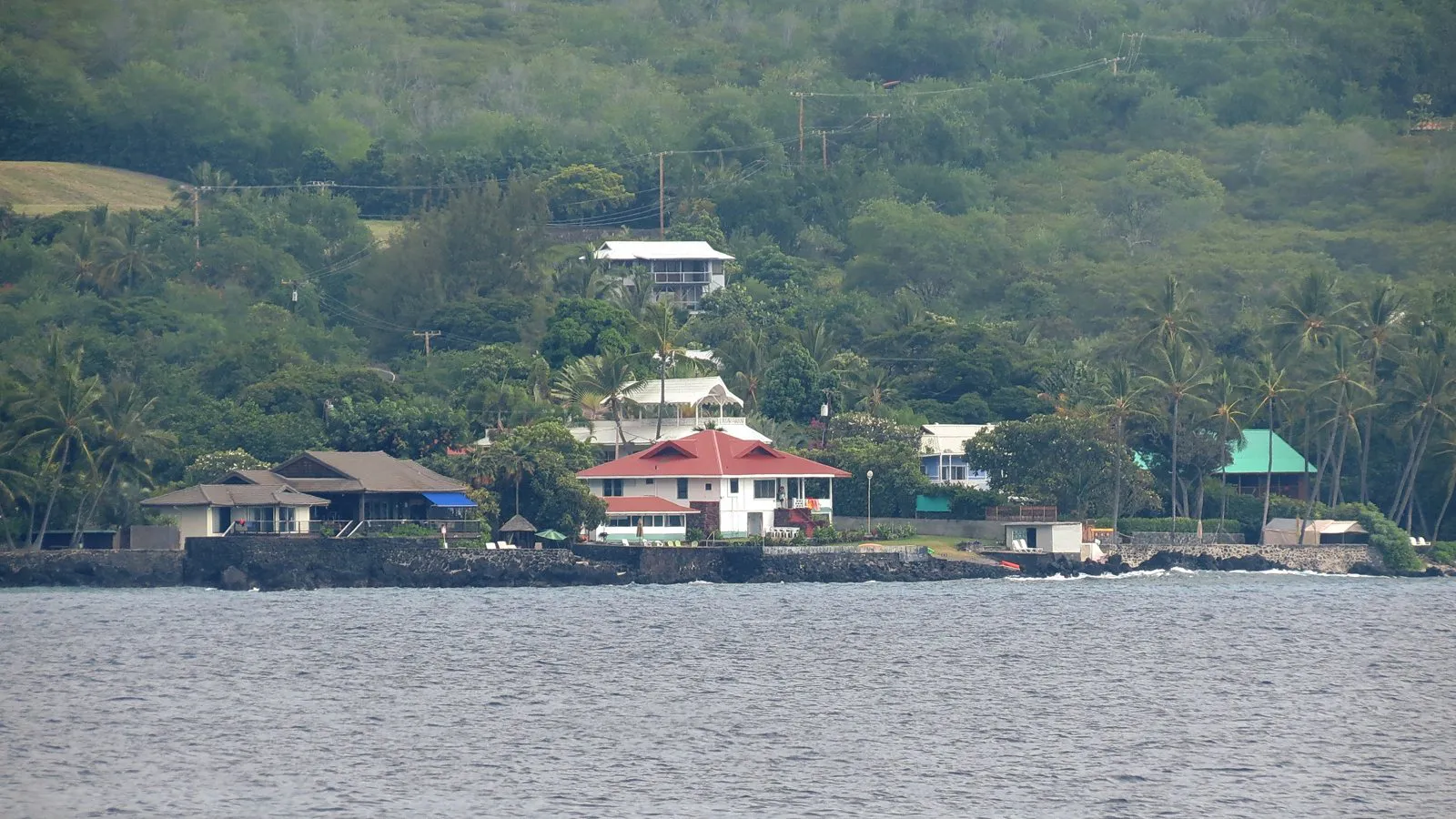
South of Kailua-Kona, the Mamalahoa Highway runs along the mountain through small towns and coffee farms, with views down to the ocean and Kealakekua Bay. Upslope it is greener and cooler; down near the coast it is dry and hot.
Buyers come for land, views and a slower pace. Here is what to check.
Homes, farms and land
Most sales are single-family homes, many on an acre or more, and agricultural parcels, some with working coffee or fruit orchards. There are few condos. Agricultural zoning limits dwellings and requires farm use, and some farms carry agricultural dedication for property tax. Ask what the county has permitted on the property, and whether there is an ohana unit.
These are October 2026 median prices from the Title Guaranty Hawaii market report for Hawaii Island (effective November 2, 2026). Title Guaranty is a Hawaii title and escrow company, and its free monthly report compiles the island's MLS sales statistics by tax district. One month is a small sample, so treat a district median as a starting point and look at actual comparable sales.
Lava zones and hazards
The U.S. Geological Survey divides Hawaii Island into lava-flow hazard zones from 1 (highest) to 9 (lowest). Zone 1 covers the summits and rift zones of Kilauea and Mauna Loa; Zone 2 is the land next to and downslope of those rift zones. The zones describe long-term probability, not a forecast, and USGS is updating the map, which still dates from 1992. Zone matters for insurance and financing. When private insurers decline a home, the Hawaii Property Insurance Association is the market of last resort: it requires at least two declinations, offers dwelling limits from $50,000 to $450,000, and generally costs more for less coverage. Ask your lender and an insurance agent about a specific address before you are in contract.
South Kona sits on Mauna Loa's west flank. In 1950, flows from Mauna Loa's Southwest Rift Zone reached the ocean south of here, one of them in about 17 hours according to the USGS. Check the zone for the exact parcel.
Water, roads and wastewater
Some properties are on county water; others rely on catchment tanks. Many lots are on steep private roads, so access agreements and road maintenance matter. Many rural homes on both islands still use cesspools. State law requires every cesspool in Hawaii to be upgraded, converted or connected to sewer by 2050, so a buyer should know what system a property has and what replacing it would involve.

Vacation rental rules
Hawaii County's 2018 short-term vacation rental law (Ordinance 2018-114) allows new unhosted rentals only in certain districts: the V, CG and CV zones, residential and commercial zones inside the General Plan's resort areas, and RM-zoned condominiums. Outside those areas, only rentals that were operating before April 1, 2019 and hold an annually renewed nonconforming use certificate can continue. Since September 1, 2026 the county also requires every transient vacation rental, hosted or not, to register through its online portal under Ordinance 25-50, with a grace period through the end of 2026. Condo association rules can be stricter than the county's. Most South Kona neighborhoods are residential or agricultural, where new unhosted rentals are not allowed unless the property already holds a nonconforming use certificate.
Nightly rental income is taxed separately from property tax: the state transient accommodations tax is 11% as of January 1, 2026, each county adds a 3% county TAT, and general excise tax is 4.5% in both Maui County and Hawaii County, so plan on about 18.5% of gross rent before income tax.
Land tenure
Most Hawaii Island homes and lots sell fee simple. Leasehold still appears in some Kona-side condos and older subdivisions, and Department of Hawaiian Home Lands homestead leases have their own eligibility rules. On rural lots, I look closely at legal access, road maintenance agreements on private roads, and whether utilities actually reach the parcel.
Getting around
From Kona International Airport, Captain Cook is about 35 to 50 minutes, depending on Kona traffic. Kailua-Kona is 20 to 30 minutes north. These are our own estimates for light traffic, not official figures.
Property taxes
Hawaii County sets rates by class each May. A full-time owner who files for the home exemption is taxed in the Homeowner class, and the exemption also lowers the taxable value. Second homes and vacation rentals are generally taxed in the Residential class, which now has three tiers.
| Hawaii County class (FY July 1, 2026 - June 30, 2027) | Rate per $1,000 of net taxable value |
|---|---|
| Homeowner | $5.75 |
| Residential (non-homeowner) | $11.10 below $2M; $14.50 from $2M to $4M; $17.00 above $4M |
| Long-term rental | $7.75 |
| Apartment | $11.70 |
| Hotel and resort / Conservation | $11.55 |
| Agricultural or native forests | $9.35 |
| Affordable rental housing | $5.75 |
Illustration only: a home with $800,000 of taxable value would be about $4,600 a year in the Homeowner class before the home exemption, and about $8,880 a year in the Residential class. The exemption amount depends on the owner, so I have the county's numbers checked for the specific property.
Land in qualified agricultural use may be taxed in the agricultural class at $9.35 per $1,000, under the county's dedication rules.
South Kona real estate FAQ
How much does a house cost in South Kona?
The Title Guaranty Hawaii market report shows 9 South Kona single-family sales in October 2026 at a median of $810,000.
Can I buy a coffee farm in South Kona?
Yes, working coffee farms come up for sale. Check agricultural zoning, water, any agricultural dedication for taxes, labor and processing arrangements, and what dwellings are permitted.
What lava zone is Captain Cook in?
South Kona is on Mauna Loa's west flank. Look up the specific parcel on the USGS lava-flow hazard zone map before you make an offer.
How do I find the lava zone for a property?
Look up the parcel on the U.S. Geological Survey lava-flow hazard zone map (zones 1 to 9, with Zone 1 the highest hazard). The map dates from 1992 and is being updated, and your lender and insurer may have their own rules for Zones 1 and 2.
What are property taxes on a South Kona home?
Using Hawaii County's July 2026 to June 2027 rates, $800,000 of taxable value would be about $4,600 a year in the Homeowner class ($5.75 per $1,000) before the home exemption, or about $8,880 a year in the Residential class used for most second homes and rentals.
Do South Kona homes have county water?
Some do; many rely on catchment. Confirm the source and test the system during your inspection.
How far is Captain Cook from Kona airport?
Our estimate is about 35 to 50 minutes in light traffic.
Can Tony help me buy in South Kona?
Yes. My team is based on Oahu, and for Hawaii Island purchases we help buyers through eXp Realty's statewide network, including referrals to agents who work South Kona every day. Call or text (808) 201-3577.
Keep reading
- Kailua-Kona
- Waikoloa
- Kohala Coast
- Waimea
- Hilo
- Puna
- Volcano Village
- Kau
- Big Island real estate overview
- Big Island market report
- Which Hawaiian island should I live on?
- Cost of living in Hawaii
Sources
- Title Guaranty, Hawaii Island Residential Sales Report, October 2026 (effective November 2, 2026; compiles Hawaii Information Service and board statistics), www.tghawaii.com/wp-content/uploads/Residential-Sales-Report-Hawaii-10.2026.pdf, read November 13, 2026.
- Hawaii Island REALTORS, Hawaii Island statistics, hawaiiislandrealtors.org/hawaii-island-statistics, accessed November 13, 2026.
- Hawaii County Council, Notice of Real Property Tax Rates for Fiscal Year 2026-2027 (Resolution 574-26, adopted May 21, 2026), statelegals.staradvertiser.com/2026/06/13/0001529053-02, published June 13, 2026.
- Title Guaranty, Real Property Tax Rates 2026-2027 (tier thresholds by county), www.tghawaii.com/wp-content/uploads/RPT-Rates-2026-2027.pdf, fiscal year July 1, 2026 to June 30, 2027.
- County of Hawaii Planning Department, Short-Term Vacation Rentals (Ordinance 2018-114 and Rule 23), www.planning.hawaiicounty.gov/resources/short-term-vacation-rentals, accessed November 13, 2026.
- Hawaii Tribune-Herald, "TVR registration takes effect" (Ordinance 25-50 registration from September 1, 2026), www.hawaiitribune-herald.com/2026/09/08/hawaii-news/tvr-registration-takes-effect, September 8, 2026.
- County of Hawaii, transient vacation rental registration portal, www.hawaiicountytar.com, accessed November 13, 2026.
- Hawaii Department of Taxation, Announcement 2025-03, transient accommodations tax law changes (state TAT 11% from January 1, 2026), files.hawaii.gov/tax/news/announce/ann25-03.pdf, 2025.
- Hawaii Department of Taxation, County Surcharge on General Excise and Use Tax, tax.hawaii.gov/geninfo/countysurcharge, accessed November 13, 2026.
- U.S. Geological Survey, Hawaiian Volcano Observatory, Lava Flow Hazard Zones and Flow Forecast Methods, Island of Hawaii, www.usgs.gov/observatories/hvo/science/lava-flow-hazards-zones-and-flow-forecast-methods-i, accessed November 13, 2026.
- Hawaii Property Insurance Association, FAQ, www.hpiainfo.com/coverage-information/faq, accessed November 13, 2026.
- State of Hawaii DLNR, Flood Hazard Assessment Tool, fhat.hawaii.gov, accessed November 13, 2026.
- Hawaii Emergency Management Agency, tsunami evacuation zones, dod.hawaii.gov/hiema/tsunami-evacuation-zones, accessed November 13, 2026.
- Hawaii Department of Health, cesspools and the 2050 conversion requirement, health.hawaii.gov/wastewater/home/cesspools, accessed November 13, 2026.
Tony Kawaguchi, REALTOR (RS-66616), The Kawaguchi Group, eXp Realty (RB-21841). Selling in Hawaii since 2005. Phone (808) 201-3577. The Kawaguchi Group is based on Oahu; for neighbor-island purchases we work with buyers through eXp Realty's statewide network, including referrals to agents who work those areas every day. This page is general information, not legal, tax, insurance or financial advice. Market statistics are deemed reliable but not guaranteed and can be revised. Drive times are our own estimates for light traffic and will vary. Photos are of the general area and are not listings.